
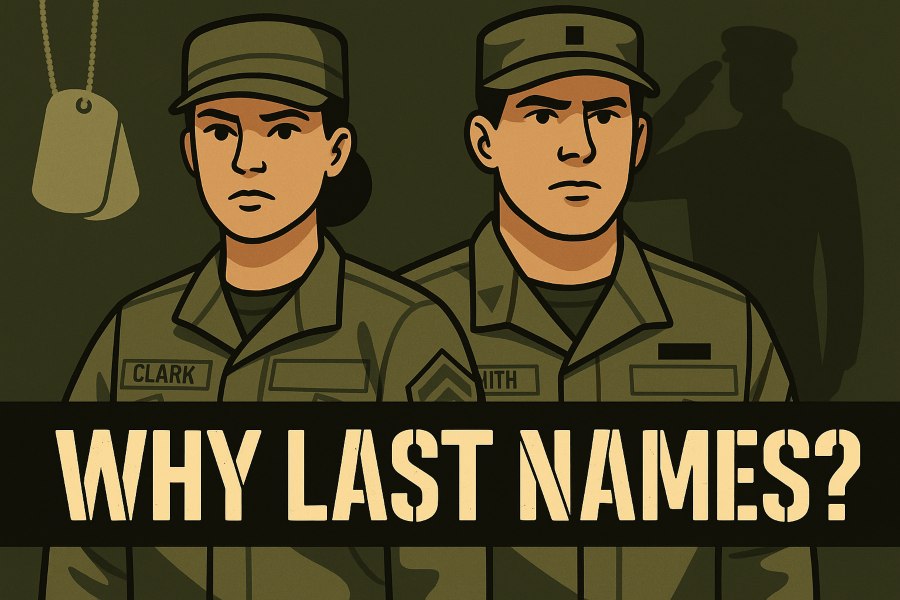
In the high-stakes world of military service, where precision and order reign supreme, one peculiar custom stands out: the near-universal practice of addressing personnel by their last names. Imagine stepping off the bus at basic training, your civilian identity stripped away as drill instructors bark orders using only your surname. “Smith, drop and give me twenty!” This isn’t just a quirk of military culture—it’s a deeply ingrained system with roots in history, psychology, and practicality. But why exactly does the military favor last names over first names? This blog post dives deep into the reasons, exploring everything from historical origins to modern implications. Whether you’re a veteran reminiscing about your service days or a curious civilian, understanding this tradition sheds light on the unique dynamics of armed forces life.
At its core, using last names fosters discipline, reduces confusion, and reinforces hierarchy in an environment where lives depend on clear communication and unity. We’ll break it down step by step, examining how this practice evolved and why it persists today. By the end, you’ll see how something as simple as a name can shape an entire institution.
The Historical Roots of Military Naming Conventions
The use of last names in the military isn’t a modern invention; it draws from centuries of organizational needs in warfare. To appreciate why surnames dominate military address, we must trace back to how armies structured themselves historically.
Origins in Ancient Armies
In ancient times, militaries often operated on a more personal scale, with soldiers known by first names, nicknames, or tribal affiliations. For instance, in Roman legions, soldiers were identified by their cognomen (a kind of surname or nickname) alongside their praenomen (first name) and nomen (family name). This tria nomina system helped distinguish individuals in growing armies, especially as the Roman Empire expanded and incorporated diverse recruits. Historians note that as armies swelled to tens of thousands, simple first-name address became impractical—leading to early reliance on family names or descriptors for clarity.
Fast-forward to medieval Europe, where feudal armies used titles and surnames tied to land or nobility. Knights were often addressed by their family names, like “de Montfort,” to signify lineage and authority. This wasn’t just about identification; it reinforced social hierarchies, ensuring that commands flowed from high-born leaders to common soldiers. In non-Western contexts, such as ancient Chinese armies, family names (xing) were used from antiquity, emphasizing clan loyalty over individual identity. These early practices laid the groundwork for modern military naming, where last names serve as a neutral, hierarchical identifier.
Evolution in Modern Militaries
The shift to standardized last-name usage accelerated during the Age of Enlightenment and the rise of professional standing armies. In the 17th and 18th centuries, European nations like Sweden implemented the indelningsverket system, where soldiers were allotted new surnames upon enlistment to avoid confusion and create a distinct military identity. These “soldier’s names” were often nature-inspired or descriptive, such as “Stark” (strong) or “Björk” (birch), and became common across regiments. This was crucial in provinces where common first names like “Anders” could apply to dozens of men in a single unit.
In the United States, the tradition solidified during the Revolutionary War and was formalized in the 19th century. Frontier armies saw enlisting under fake names as common, but official records relied on surnames for tracking. By World War I, the German General Staff’s use of code names for operations influenced broader naming conventions, though personal address stuck to surnames for efficiency. Post-WWII, as militaries became more bureaucratic, last names became the default on uniforms, dog tags, and rosters, embedding the practice in global armed forces.
Specific Examples from History
Consider the Swedish military’s surname system, which persisted until the 20th century. Upon joining, a recruit might discard his patronymic (like “Andersson”) for a military-specific name to prevent mix-ups in payroll or commands. In the U.S. Army, during the Civil War, regiments often had multiple “Johns” or “Williams,” making last names essential for muster rolls. Even today, echoes of this history appear in naming military installations after historical figures, though that’s more commemorative than operational. These examples illustrate how historical necessities shaped a custom that’s now second nature.
Practical Reasons for Using Last Names
Beyond history, the military’s preference for last names boils down to sheer practicality. In an organization with millions of personnel, efficiency is key.
Avoiding Confusion in Large Groups
One primary reason is to eliminate ambiguity. In a platoon, there might be several “Mikes” or “Sarahs,” but surnames are far more unique. This reduces errors during roll calls, assignments, or emergencies. As one veteran notes, “Your surname is unique to you in a Battalion,” making it a reliable identifier alongside service numbers. In combat scenarios, shouting “Johnson, cover left!” leaves no room for doubt, potentially saving lives.
This extends to administrative tasks. Military records, from enlistment papers to medical files, prioritize last names for sorting and retrieval. In diverse forces like the U.S. military, where recruits hail from varied cultural backgrounds, last names provide a consistent anchor, avoiding pronunciation issues with uncommon first names.
Efficiency in Communication
Military communication demands brevity and clarity. Using last names streamlines interactions, especially in hierarchical settings. Enlisted personnel address superiors by rank and surname, like “Captain Ramirez,” which conveys respect without excess words. Among peers, dropping to just the last name fosters quick camaraderie while maintaining professionalism.
In radio transmissions or briefings, this convention cuts through noise. Imagine a chaotic battlefield: “Smith, advance!” is punchier and less prone to mishearing than a full name. This efficiency is drilled from day one in basic training, where recruits learn that first names “no longer matter.”
Identification and Record-Keeping
Last names tie into broader identification systems. Dog tags list surname first, followed by first initial, for quick ID in the field. In legal contexts, like courts-martial, surnames ensure precise referencing. Even in allied operations, this standard helps multinational forces coordinate without cultural naming barriers.
For married couples in the military, shared surnames can signal relationships, aiding in assignment policies, though common names complicate this. Overall, the practical benefits make last names indispensable for operational smoothness.
Promoting Discipline and Hierarchy
The use of last names isn’t just logistical—it’s a tool for instilling discipline and reinforcing the chain of command.
Establishing Authority
By addressing others by rank and surname, the military emphasizes roles over individuals. This depersonalizes interactions, focusing on duty rather than personal bonds. Superiors are “Sergeant Lee,” not “Tom,” which maintains a professional distance and upholds authority. This custom traces back to customs and courtesies manuals, where warrant officers are “Mr. [Last Name]” to denote respect.
In training, this breaks down civilian egos, molding recruits into a cohesive unit. Psychologically, it shifts identity from “me” to “us,” reducing insubordination.
Fostering a Sense of Unity
Last names promote equality among ranks. Regardless of background, everyone is “Private [Surname],” leveling the playing field. This uniformity builds esprit de corps, where personal differences fade in favor of shared mission. In diverse militaries, it mitigates biases tied to first names, which might reveal ethnicity or gender.
Studies on military identity highlight how this practice aids in transitioning to a collective mindset, crucial for morale and effectiveness.
Psychological Impact on Recruits
On a deeper level, using last names can trigger an identity shift. Recruits often report feeling “reborn” as their first name vanishes, symbolizing commitment to service. However, this can lead to post-service challenges, like aversion to last-name address in civilian life. Psychologically, it fosters resilience by emphasizing function over self, though it may contribute to adjustment issues upon discharge.
Cultural and Social Aspects
Military naming extends into broader culture, influencing how service members interact socially.
Comparison with Civilian Life
In civilian workplaces, first names dominate for approachability, but in high-risk fields like police or firefighting, last names persist for similar reasons—professionalism and quick ID. This contrast highlights the military’s unique demands; civilians might find it impersonal, but it suits the structured environment.
Socially, veterans often carry this habit, calling old comrades by surnames years later, preserving bonds.
Variations Across Different Branches and Countries
Branches vary: Marines might use last names rigidly, while some Air Force units allow first names off-duty. Internationally, the British Army uses surnames similarly, but Scandinavian forces historically assigned new ones. In informal militaries like Israel’s, first names are common among equals.
Impact on Personal Identity
For individuals, this can redefine self-perception. Women changing names upon marriage face additional layers, balancing personal and professional identities. It also affects mental health support, as identity salience post-service influences well-being.
Exceptions to the Rule
Not every interaction sticks to last names—exceptions exist for rapport or necessity.
When First Names Are Used
In close-knit units, like special forces, first names emerge off-duty to build trust. Senior leaders might use them for motivation, humanizing commands.
Special Units or Informal Settings
Aviation callsigns override names entirely, like “Maverick.” In social events, first names relax the atmosphere, though rank still applies.
The Modern Military and Naming Practices
Today, evolving norms challenge traditions.
Changes Over Time
With inclusivity pushes, militaries adapt—e.g., addressing by preferred pronouns or names. Digital records enhance surname utility, but cultural shifts toward informality question its rigidity.
Inclusivity and Diversity Considerations
Diverse forces consider name pronunciation and cultural sensitivity, ensuring last names don’t alienate. Policies on name changes for transgender personnel reflect this.
Conclusion: A Lasting Legacy
The military’s use of last names is a multifaceted tradition rooted in history, practicality, and psychology. It avoids confusion, enforces discipline, and fosters unity in a demanding world. While exceptions and modern changes exist, this custom endures, symbolizing the sacrifice of personal identity for collective strength. As militaries evolve, it may adapt, but its core purpose—efficient, respectful operation—remains timeless. If you’ve served, does this ring true? Share your stories below.